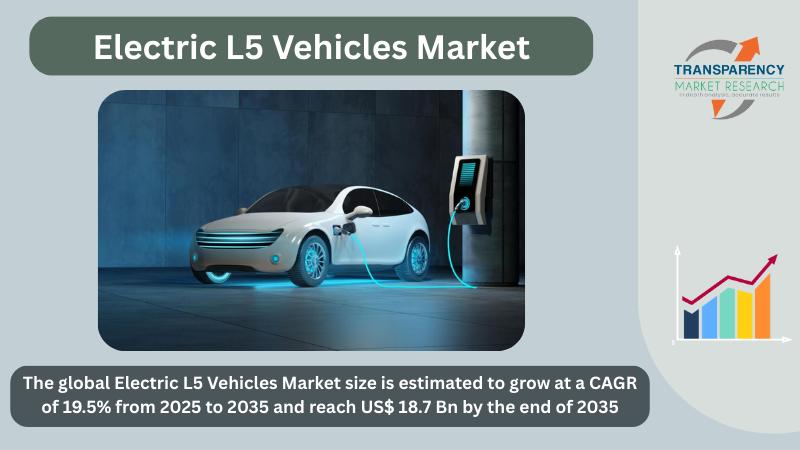
The global electric L5 vehicles market was valued at US$ 2.4
Billion in 2024 and is anticipated to reach US$ 18.7 Billion by 2035. The
market is set to grow at an impressive CAGR of 19.5% from 2025 to 2035. Rising
demand for sustainable urban mobility and government incentives for electric
vehicle adoption are key drivers. Increasing use of electric L5 vehicles in
shared mobility and last-mile delivery services is also contributing to rapid
market expansion.
Get Your Report Sample Copy Now - Discover Key Insights Instantly! https://www.transparencymarketresearch.com/sample/sample.php?flag=S&rep_id=86664
Driven by government incentives, rising fuel costs, environmental
regulations, and the exploding e-commerce sector, the global Electric L5
Vehicles Market is expected to grow at a CAGR 19.5% from 2025 to 2035. This
market presents immense opportunities for OEMs, battery technology providers,
component suppliers, fleet operators, and ESG-conscious investors.
Analysis of Key Players in the Electric L5 Vehicles Market
Key players such as Mahindra Electric, Piaggio, Kinetic Green, Bajaj Auto,
and Omega Seiki Mobility are at the forefront of the Electric L5 Vehicles
market, driven by their robust regional presence, expanding distribution
networks, and continuous innovations in battery technology and vehicle design.
These companies have introduced a diverse portfolio of electric three-wheelers
tailored for both passenger and cargo transport. With growing urban demand and
the influx of start-ups and local manufacturers, the market is becoming
increasingly competitive, putting greater emphasis on affordability and
performance.
Strategic partnerships, government incentives, and a strong focus on
sustainability have further strengthened the market positions of these players.
In the broader global context, Chinese manufacturers such as Yadea and Dongfeng
are poised to disrupt the market by leveraging economies of scale and cost
advantages, setting the stage for intensified international competition.
Notable players featured in the Electric L5 Vehicles Market report include:
Mahindra Last Mile Mobility (Mahindra Group), Bajaj Auto Ltd., Piaggio Vehicles
Pvt. Ltd., Euler Motors, Omega Seiki Mobility, TVS Motor Company Limited, ATUL
Auto Limited, TI Clean Mobility Private Limited, Motors Pvt. Ltd., Altigreen
Propulsion Labs, BILITI Electric Inc., BEMAC Corporation, and Kinetic Green
Energy & Power Solutions Ltd.
These companies are profiled based on various parameters such as company
overview, financial performance, strategic initiatives, product offerings,
business segments, and recent developments.
Key Developments in the Electric L5 Vehicles Market
• August 2024: Mahindra Last Mile Mobility Limited launched the new e-Alfa
Plus, engineered for daily usage with a high-performance Permanent Magnet
Synchronous Motor (PMSM). It delivers a peak power of 1.95 kW at 2600 r/min and
a maximum torque of 26.9 Nm at 200 r/min, reinforcing Mahindra's leadership in
durable and efficient electric three-wheelers.
• May 2024: Bajaj Auto Ltd. entered a strategic partnership with Flipkart
to integrate 1,000 advanced electric three-wheelers from its E-TEC Cargo range
into Flipkart's last-mile delivery fleet. This collaboration supports
Flipkart's sustainability goals and demonstrates the commercial viability of
EVs in e-commerce logistics.
• February 2025: Euler Motors signed a long-term MoU with Tata Power Renewables
to deploy fast chargers for Euler's customers. This alliance enhances the
charging infrastructure, thereby supporting the broader adoption of electric
three-wheelers and addressing a key challenge in EV adoption.
Key Market Drivers
1. Urbanization and Last-Mile Logistics Demand
• As megacities become denser, compact electric three-wheelers and
quadricycles are ideal for maneuvering in narrow lanes, traffic zones, and
delivery routes.
• The rise of quick-commerce (q-commerce) and express delivery services is
creating urgent demand for reliable, cost-efficient last-mile transport
vehicles.
2. Government Incentives and EV Policy Support
• Countries like India, China, and Thailand are offering substantial
subsidies, tax exemptions, and financing support for L5 electric vehicles under
their national EV policies.
• Import duty relaxations, battery swapping infrastructure, and state-level EV
mobility missions are creating a favorable landscape.
3. Cost Efficiency and Low TCO
• Compared to traditional ICE (internal combustion engine) three-wheelers,
electric L5 vehicles offer lower running costs, minimal maintenance, and higher
ROI, making them highly attractive to fleet operators and self-employed
drivers.
• With battery-as-a-service (BaaS) models and subscription-based fleets,
upfront cost barriers are rapidly diminishing.
4. Environment and Emission Regulations
• Global urban centers are rolling out Low Emission Zones (LEZs) and
Net-Zero targets, restricting fossil-fueled mobility.
• Electric L5 vehicles, with zero tailpipe emissions and low noise pollution,
are perfect candidates for compliance.
Unique Opportunities for Stakeholders
✦ Mass Fleet Electrification in
Emerging Markets
• India is the largest three-wheeler market in the world, and its shift to
electrification is creating unparalleled opportunities for L5 EV manufacturers
and component suppliers.
• Southeast Asia and Africa are following suit, with L5 EVs replacing
traditional tuk-tuks and auto rickshaws at scale.
✦ Smart Urban Mobility Projects
• L5 EVs are being integrated into smart cities as micro-mobility
solutions, especially in Europe and the Middle East.
• Governments and municipal bodies are collaborating with private companies for
EV-powered public transport and shared ride models.
✦ Battery Swapping & Modular
Powertrains
• The integration of modular battery packs and swapping stations increases
operational uptime and reduces range anxiety for commercial use cases.
• Startups are focusing on standardized battery interfaces, making L5 EVs more
user-friendly and interoperable.
✦ Electrification of
Agro-Logistics and Rural Transport
• L5 electric vehicles are increasingly used in rural logistics,
agricultural produce transport, and school or healthcare shuttle services,
particularly in regions with unreliable fuel supply.
• Solar-integrated L5 vehicles are emerging in off-grid rural economies.
Key Segments and Applications
Vehicle Types:
• Passenger L5 EVs (auto-rickshaws, tuk-tuks, quadricycle taxis)
• Cargo L5 EVs (logistics carriers, delivery pods, e-loaders)
Use Cases:
• E-commerce last-mile delivery
• Urban shared mobility / ride-hailing
• Small business & retail distribution
• Government transport and fleet services
• Rural & peri-urban commute
Regulatory Landscape and Incentive Schemes
• India's FAME-II scheme offers substantial subsidies for electric L5
vehicles, along with state-level programs in Delhi, Maharashtra, and Tamil
Nadu.
• China's New Energy Vehicle (NEV) policy supports three-wheeled EV
manufacturers through tax rebates and production-linked incentives.
• European Union classifies quadricycles under L5e with vehicle-specific energy
efficiency targets.
• Cities like Paris, Amsterdam, and Barcelona are pushing electric
micro-mobility with dedicated lanes and charging hubs.
Supply Chain and Manufacturing Insights
• Tier-1 and Tier-2 suppliers of motors, controllers, axles, suspension
systems, and digital dashboards are expanding capabilities to meet L5 EV specs.
• Local manufacturing hubs in India, China, and Thailand are scaling up
production capacity, reducing dependency on imports.
• The ecosystem is also witnessing a rise in contract manufacturing, battery
leasing, and fleet service platforms.
Investment Potential and Growth Projections
The Electric L5 Vehicles Market offers exceptional ROI across multiple
investment models:
• OEM-led equity investment for scale and technology upgrade.
• Venture capital funding in startups focused on smart fleet management,
battery swapping tech, and integrated mobility solutions.
• Public-private partnerships (PPPs) for infrastructure development, especially
in charging and fleet electrification.
Forecasts:
• The global electric L5 vehicle market size is projected to cross USD 15
billion by 2030, up from USD 6.2 billion in 2024.
• Asia Pacific will continue to dominate with over 60% market share, led by
India and China.
Strategic Recommendations
For Manufacturers:
• Focus on platform-based vehicle design that allows for cargo/passenger
modularity.
• Strengthen R&D in battery thermal management, lightweight structures, and
extended-range powertrains.
• Build partnerships with logistics players, e-commerce platforms, and fleet
aggregators for large-scale orders.
For Suppliers:
• Develop standardized, scalable components for motors, controllers, and
battery packs.
• Establish regional service and parts centers to ensure vehicle uptime for
commercial fleets.
• Tap into rural distribution networks to reach underserved L5 vehicle
customers.
For Investors:
• Back B2B fleet companies that are electrifying logistics and urban
transportation.
• Invest in charging and battery swapping infrastructure companies with
long-term service agreements.
• Monitor opportunities in cross-border expansion of L5 platforms into LATAM
and Africa.

